
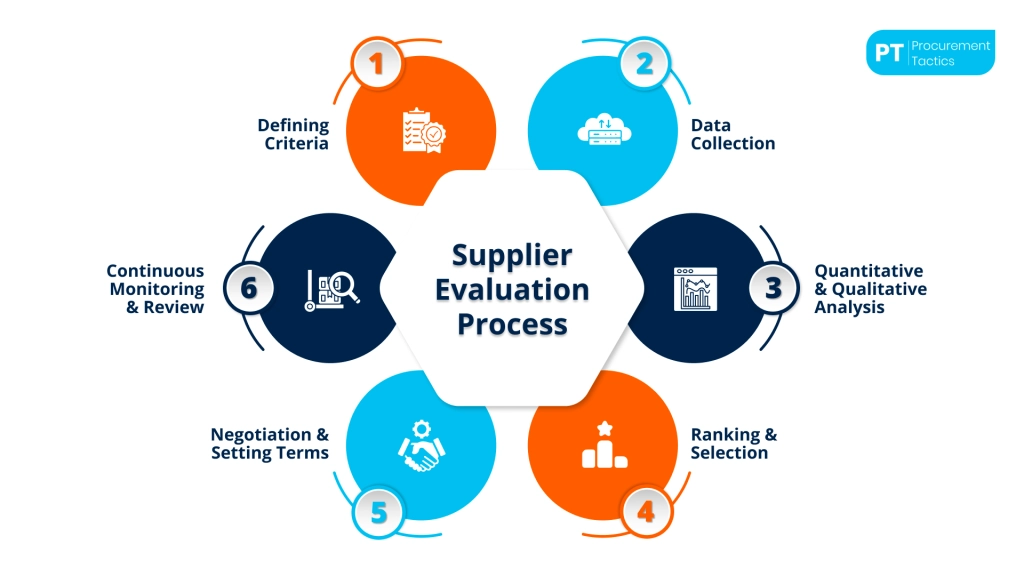
Why Supplier Evaluation Is Where Most Buyers Fail
Many sourcing problems do not come from “bad factories,” but from weak evaluation processes. Buyers often rush decisions, rely on surface-level signals, or treat supplier selection as a one-time event.
In reality, professional buyers evaluate manufacturing suppliers as a progressive filtering process. Each stage is designed to reveal specific risks while limiting exposure.
This step-by-step approach explains why experienced buyers can work successfully with overseas manufacturers while inexperienced buyers struggle—even when dealing with the same factories.
Step 1: Initial Supplier Screening (Eliminate the Obvious Risks)
The first step is not to find the “best” supplier, but to eliminate those that clearly do not fit.
At this stage, buyers focus on basic alignment:
- Does the supplier actually manufacture the product category?
- Do they show evidence of production capability?
- Is their communication coherent and responsive?
Red flags during initial screening include:
- Vague descriptions of processes or equipment
- Inconsistent company information across platforms
- Reluctance to discuss technical details
This stage is about removing noise, not making final decisions.
Step 2: RFQ Quality Test (How Suppliers Respond Matters)
A well-prepared RFQ is one of the strongest evaluation tools buyers have.
Professional buyers include:
- Drawings or technical specifications
- Material requirements
- Tolerances and surface finish
- Target quantity and delivery expectations
What buyers evaluate is not just the quote—but how the supplier reacts.
Reliable suppliers typically:
- Ask clarifying questions
- Identify manufacturability risks
- Confirm assumptions before pricing
Suppliers who quote instantly without questions often rely on assumptions that later turn into disputes.
Step 3: Quote Analysis (Price Is Only One Variable)
Experienced buyers do not compare quotes line by line based only on unit price.
Instead, they analyze:
- Material assumptions
- Process steps included or excluded
- Inspection scope
- Packaging and logistics terms
Large price differences usually signal different assumptions, not superior efficiency.
Reliable suppliers clearly state what is included—and what is not. Ambiguity at this stage almost always leads to cost overruns or quality disputes later.
Step 4: Technical Capability Validation
Once pricing aligns, buyers validate whether the supplier can actually execute.
This includes evaluating:
- Equipment type and capacity
- Process control methods
- Inspection tools and procedures
- Experience with similar parts or products
Strong suppliers can explain how they will make the product, not just that they can.
Weak suppliers rely on generic assurances rather than specific process explanations.
Step 5: Communication Pattern Assessment
Communication is one of the most overlooked evaluation factors—and one of the most predictive.
Buyers observe:
- Response clarity vs response speed
- Willingness to document decisions
- Consistency across conversations
Reliable suppliers:
- Confirm understanding in writing
- Flag potential risks early
- Provide evidence instead of promises
Suppliers who always say “yes” without analysis often create problems downstream.
Step 6: Trial Orders (The Real Evaluation Begins)
No evaluation is complete without a trial order.
Trial orders allow buyers to test:
- Specification interpretation
- Process repeatability
- Inspection discipline
- Packaging accuracy
- Problem-handling behavior
Reliable suppliers treat trial orders seriously—even when volumes are small.
How a supplier handles issues during a trial order is often more important than whether issues occur.
Step 7: Quality and Inspection Review
After receiving trial samples or first batches, buyers evaluate quality systematically.
This includes:
- Dimensional consistency
- Material verification
- Surface finish
- Defect rates
Just as important is how the supplier reacts to feedback:
- Do they acknowledge issues?
- Do they propose corrective actions?
- Do they prevent recurrence?
Defensiveness is a warning sign. Ownership is a positive signal.
Step 8: Delivery and Logistics Performance
Reliable manufacturing is not only about making parts—it’s about delivering them correctly.
Buyers evaluate:
- Lead time accuracy
- Packaging quality
- Shipping documentation
- Coordination with freight partners
Suppliers who consistently miss delivery commitments create planning and inventory risk, even if product quality is acceptable.
Step 9: Scalability and Consistency Check
A supplier that performs well on a small order may not scale smoothly.
Buyers assess:
- Capacity limits
- Production scheduling discipline
- Staff stability
- Quality consistency across batches
Reliable suppliers are honest about capacity constraints and growth limits.
Step 10: Long-Term Behavior Evaluation
The final evaluation happens over time.
Buyers monitor:
- Consistency across repeat orders
- Response to design changes
- Cost stability
- Proactive improvement suggestions
Reliable suppliers improve with familiarity. Unreliable suppliers repeat the same mistakes.
Common Evaluation Mistakes Buyers Make
- Choosing suppliers based on lowest quote
- Overvaluing certifications
- Skipping trial orders
- Ignoring communication signals
- Scaling too fast
Most sourcing failures are the result of process shortcuts.
A Simple Evaluation Framework Buyers Actually Use
Experienced buyers mentally group evaluation into three phases:
- Before production: RFQ quality, technical feedback, quote clarity
- During production: Trial execution, communication, inspection discipline
- After delivery: Quality consistency, delivery reliability, corrective action
Suppliers that pass all three phases gradually earn higher volumes and long-term trust.
Conclusion
Buyers do not evaluate manufacturing suppliers in one step—they do it progressively.
Each stage reveals different risks, from technical misunderstanding to operational instability.
By treating supplier evaluation as a structured, step-by-step process, buyers reduce uncertainty, avoid costly surprises, and build reliable manufacturing partnerships over time.
In global sourcing, discipline—not luck—is what separates successful buyers from frustrated ones.