
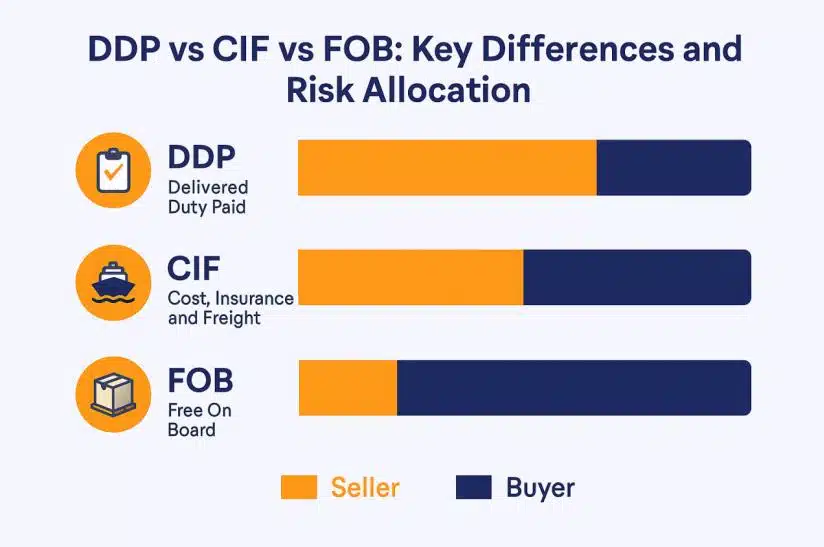
Why FOB, CIF, and DDP Matter More Than Buyers Think
When sourcing internationally—especially from manufacturing hubs like China—many buyers focus heavily on unit price while overlooking shipping terms. However, the Incoterm used in a quotation often has a bigger impact on total landed cost, risk exposure, and delivery reliability than the part price itself.
FOB, CIF, and DDP are three of the most commonly used Incoterms in international manufacturing. They define who is responsible for transportation, insurance, customs clearance, duties, and risk at each stage of the shipment.
Misunderstanding these terms frequently leads to:
- Unexpected freight or customs costs
- Delays caused by unclear responsibility
- Difficulty comparing supplier quotes fairly
- Hidden margins embedded in logistics charges
Understanding how FOB, CIF, and DDP really work from a buyer’s perspective is essential for making informed sourcing decisions.
What FOB Means for Buyers
FOB (Free On Board) means the seller is responsible for delivering the goods to the named port of shipment and loading them onto the vessel. Once the goods are on board, risk transfers to the buyer.
Under FOB terms, the buyer typically handles:
- Ocean or air freight
- Insurance (optional but recommended)
- Customs clearance at destination
- Duties, taxes, and inland transportation
From a buyer’s perspective, FOB provides the clearest separation between product cost and logistics cost.
Advantages of FOB for Buyers
FOB is often preferred by experienced buyers because it offers:
- Full transparency over freight and insurance costs
- Freedom to choose freight forwarders
- Better control over shipping schedules
- Easier comparison between suppliers
For buyers with established logistics partners, FOB is usually the most cost-efficient and flexible option.
Disadvantages of FOB for Buyers
FOB also comes with responsibilities that some buyers may find challenging:
- More coordination with freight forwarders
- Responsibility for international shipping risk
- Greater administrative workload
For new importers without logistics experience, FOB can feel complex and risky.
What CIF Means for Buyers
CIF (Cost, Insurance, and Freight) means the seller arranges and pays for ocean freight and insurance to the destination port. Risk still transfers to the buyer once the goods are loaded onto the vessel, even though the seller pays for transport.
Under CIF terms, the buyer is typically responsible for:
- Import customs clearance
- Duties and taxes
- Inland transportation after arrival
Advantages of CIF for Buyers
CIF is attractive because it simplifies sourcing:
- The supplier handles international shipping
- Fewer logistics decisions for the buyer
- Single quoted price up to destination port
For buyers who ship infrequently or lack logistics expertise, CIF reduces coordination effort.
Disadvantages of CIF for Buyers
Despite its simplicity, CIF has several drawbacks:
- Limited visibility into freight cost breakdown
- Supplier-selected forwarders may not be cost-efficient
- Insurance coverage is often minimal
- Difficult to compare CIF quotes fairly
Many buyers discover that CIF pricing includes hidden margins or conservative freight assumptions that inflate total cost.
What DDP Means for Buyers
DDP (Delivered Duty Paid) means the seller takes responsibility for delivering goods to the buyer’s specified location, including customs clearance, duties, taxes, and inland transportation.
From a buyer’s perspective, DDP appears to be the simplest option.
Advantages of DDP for Buyers
DDP offers maximum convenience:
- One all-inclusive price
- No involvement in shipping or customs
- Minimal administrative burden
For buyers without import experience, DDP can feel like a risk-free solution.
Disadvantages of DDP for Buyers
DDP also carries the highest hidden risks:
- Limited cost transparency
- Higher overall price due to risk premiums
- Compliance risks if the seller mishandles customs
- Difficulty verifying duties and taxes
In some countries, DDP shipments may violate local customs rules if the seller is not properly registered, potentially exposing the buyer to compliance issues.
FOB vs CIF vs DDP: Buyer Responsibility Comparison
| Aspect | FOB | CIF | DDP |
|---|---|---|---|
| Product Cost Transparency | High | Medium | Low |
| Logistics Control | High | Low | Very Low |
| Buyer Administrative Effort | High | Medium | Low |
| Risk Visibility | High | Medium | Low |
| Total Cost Predictability | High (with experience) | Medium | Low (often inflated) |
Which Incoterm Is Best for Different Types of Buyers?
New or Infrequent Importers
Buyers new to international sourcing often prefer CIF or DDP due to simplicity. However, CIF is usually safer than DDP because it avoids some compliance risks while still reducing logistics complexity.
Experienced Buyers and Procurement Teams
Buyers with logistics partners and internal processes generally benefit most from FOB. The ability to control freight, insurance, and customs leads to better cost control and fewer surprises.
Cost-Sensitive or High-Volume Buyers
For high-volume or cost-sensitive sourcing, FOB almost always delivers the best long-term results. Even small freight savings per shipment add up significantly over time.
Common Buyer Mistakes When Choosing FOB, CIF, or DDP
Buyers frequently make avoidable mistakes, including:
- Comparing FOB and CIF prices directly without adjustment
- Assuming DDP is always the safest option
- Ignoring insurance coverage details under CIF
- Letting suppliers control logistics without oversight
These mistakes often lead to higher total cost rather than lower risk.
How to Choose the Right Incoterm for Your Project
Before selecting FOB, CIF, or DDP, buyers should ask themselves:
- Do we have a reliable freight forwarder?
- How important is cost transparency?
- Are we comfortable managing customs clearance?
- How critical is delivery timing?
The right Incoterm aligns with your internal capability—not just your desire for convenience.
Conclusion
FOB, CIF, and DDP are not interchangeable—they represent different trade-offs between cost, control, and convenience.
FOB offers the greatest transparency and long-term cost control, CIF provides simplicity with limited visibility, and DDP delivers convenience at the expense of flexibility and often higher hidden costs.
For buyers who want predictable pricing, reliable delivery, and scalable sourcing, understanding and choosing the right Incoterm is as important as selecting the right supplier.